Much of the GEO market sells a static answer to a moving problem.
The short answer: sometimes—but “Reddit drives AI visibility” is not a rule you can carry unchanged from one model or month to the next. Reddit can recur for prompts that benefit from lived experience. But another model, product mode, or later measurement may instead pull from reviews, directories, specialist sources, or first-party pages. Measure the actual source pattern before funding the tactic.
A study finds that Reddit appears often in a sample of AI citations. The finding becomes a headline. The headline becomes a checklist. Within weeks, agencies are telling every business to “do Reddit,” no matter what the buyer is looking for. For example:
- An emergency plumber
- Enterprise software, compared side by side
- A medical procedure, checked for safety or cost
- A restaurant for tonight
The original observation may have been accurate. The universal prescription is not. Generative search is not one ranked list with one stable algorithm. Instead, it works through a chain of decisions:
- Whether to search at all
- Which related searches to run
- What sources to retrieve
- What evidence to keep
- How to summarize that evidence
- Which claims to cite
- How to present the final answer
Each of these steps can differ by product, model, mode, prompt, location, language, date, and competitive field. A new model can change how it searches, expands the query, picks sources, and writes the answer. Even without a new model, a month of competitor and source changes can shift the available evidence. That is why AI visibility needs a dated measurement. It is not a permanent rank.
The universal-playbook trap
Most popular recommendations sound reasonable because they describe real sources of evidence. The mistake is treating one of those sources as mandatory everywhere.
The problem is not Reddit, schema, backlinks, or content. The problem is prescribing any one of them before measuring the category.
This distinction matters commercially. A business can spend a whole quarter building a community program, just because a six-month-old article said Reddit was dominant. Yet the AI products answering its highest-value questions may already rely on review platforms, local directories, service pages, and trade publications instead.
Every new model can redraw the evidence map
A provider can keep the same product name while changing what runs behind it: the model, the routing, the search stack, or how it writes the answer. Visibility can also move without any new release at all. That happens when the surrounding sources and competitors change instead.
Google confirms that AI Mode and AI Overviews may use different models and techniques. That is why their responses and supporting links can vary. OpenAI says ChatGPT search looks at the user’s request and the conversation so far, and it draws on third-party search providers and partner content. Anthropic’s API documentation describes web search that depends on the prompt and may run several times within one tool call.
None of this reveals a secret ranking formula. Together, though, it makes the point that matters for strategy: the path from question to answer keeps changing, and it depends on context.
For a provider-by-provider view, see AI Overviews vs. ChatGPT vs. Perplexity vs. Gemini.
So, is Reddit still driving AI visibility?
Reddit can be valuable. It contains firsthand language, detailed comparisons, niche expertise, and candid complaints that polished brand pages often leave out. It is a natural fit for questions such as “What failed after six months?”, “Which tool is easier for a small team?”, or “Who has actually used this contractor?”
That does not make Reddit the right answer for every prompt. Consider four questions in the same home-services market:
| Buyer question | Evidence likely to be useful | What to measure |
|---|---|---|
| “Best emergency HVAC company near me” | Local profiles, reviews, service coverage, directories, business pages | Recurring companies, local sources, review and listing gaps |
| “How much does an AC compressor replacement cost?” | Pricing guides, service pages, parts and labor explanations | Pages cited, price specificity, freshness, answer accuracy |
| “Is Company X reliable?” | Reviews, BBB or licensing sources, local media, community discussion | Sentiment, factual conflicts, source recurrence |
| “Company X vs Company Y” | Direct comparisons, service details, third-party proof, customer experience | Which facts and proof points frame each business |
If Reddit keeps showing up in the actual sources for your questions, participate honestly and build useful answer content there. If it does not show up, don’t force a Reddit program just because one broad study found a high overall citation share. Spam in that case only creates reputation risk, without building any lasting evidence.
For a responsible community approach, see Reddit and AI Visibility: How to Use Forums Without Spamming.
How to measure what matters now
Plastorium does not start with a fixed recommendation such as “build backlinks” or “post on Reddit.” It starts with the answer environment and works backward from observable differences.
First, define what “visible” means for this business question. It could mean an unprompted brand mention, a spot on a recommendation shortlist, or being a cited source. It could also mean a strong share of citations across repeated runs, accurate factual framing, or positive answer sentiment. Do not combine these different outcomes into one unexplained score.
Use the AI Visibility Audit Checklist to document the prompt panel, evidence, and implementation checks.
Driver analysis is not a leak of the algorithm
A driver analysis compares observed outcomes with measurable business traits. Say the companies that get recommended most often in the sample tend to share certain features: complete service pages, current review activity, consistent directory data, and a richer set of citations. Those features become candidates worth investigating. They are not proven causes.
A good analysis should report, in plain terms: how many companies were sampled, how much usable data each factor had, how strong the estimated effect was, how uncertain that estimate is, and where this business’s own gap sits. Weak or sparse signals should be left out, not turned into confident advice.
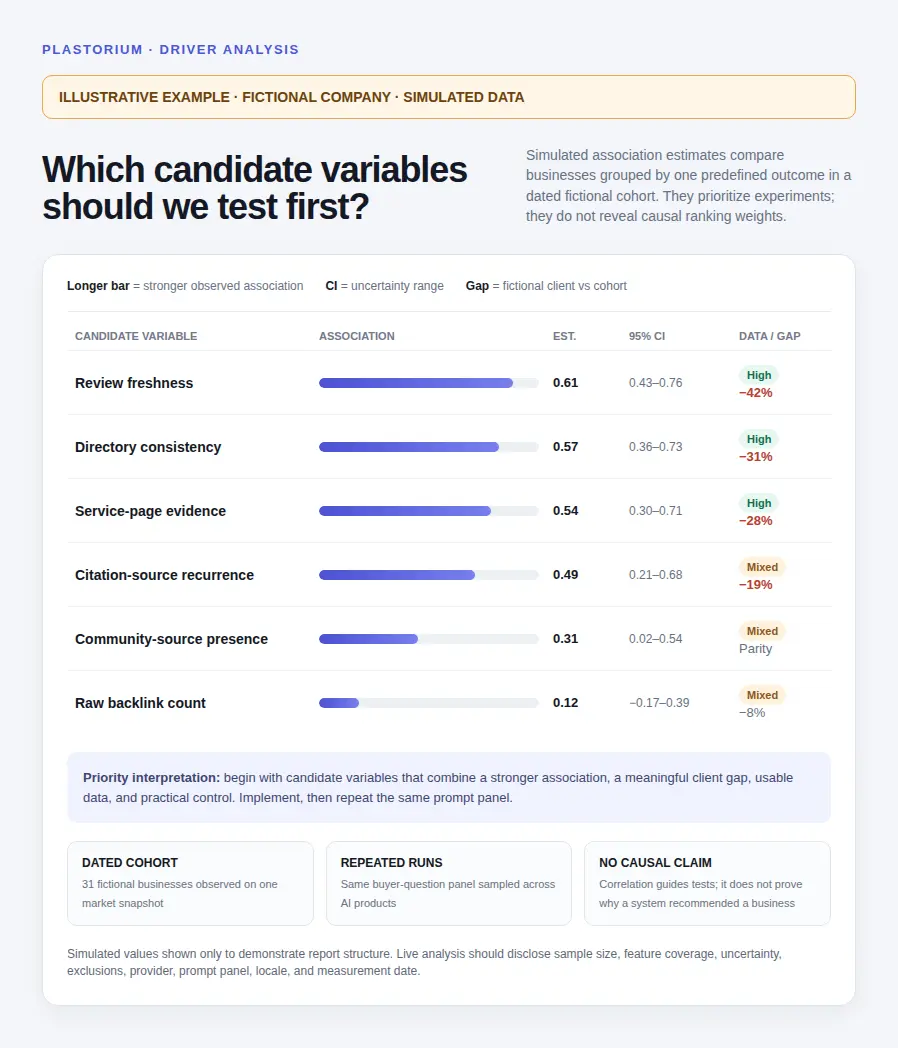
Turn associations into experiments
Suppose a test sample shows a link between review freshness and a recommendation outcome, with good data and a fairly tight range of uncertainty. That does not mean “reviews control ChatGPT.” Instead, it means this:
- Plan a compliant review-request change in advance
- Keep the same set of test prompts
- Track any major changes competitors make
- Test whether the outcome actually shifts
An improvement seen before and after the change builds confidence. But on its own, it does not prove the change caused the result — that needs a proper control or comparison.
Let the current evidence set the order of work. For example:
- If directory consistency is a bigger gap than backlinks, fix directories first.
- If price questions pull up detailed first-party pages, publish a useful pricing page.
- If community sources keep showing up for comparison prompts, support genuine expert participation there.
Translate the measured gaps into scope and cost with AI Visibility Targets You Can Actually Budget For.
Why last month’s Reddit strategy may already be wrong
A month is not a law of nature. Some categories stay stable for longer. Others shift after a provider update, a competitor’s campaign, a change in what sources are available, or normal week-to-week variation in search results. At Plastorium, we recommend monthly measurement as a practical routine for active programs. That is not a claim that every factor flips every 30 days.
The point of the monthly check is not to invent a new strategy every 30 days. It is to catch meaningful change before the team spends another quarter on an old assumption. Reddit may still show up, but maybe only for comparison prompts now. A newly deployed model may pull from a different set of sources. A competitor may earn enough recent reviews, or publish a page that answers the question directly, and change who gets mentioned. The business plan should follow this repeated evidence, not the date on an agency slide.
The comparison below shows how a team should read a changed evidence pattern. It is an illustration, not a claim about any specific Plastorium client or provider.
| Observed factor | Baseline | 30-day repeat | Operating decision |
|---|---|---|---|
| Community-source recurrence | High | Mixed | Keep useful participation; stop treating it as the default channel. |
| Review freshness gap | Moderate | Strong | Increase priority of the compliant review workflow. |
| Priority-directory coverage | Weak | Strong | Repair missing profiles on currently recurring sources. |
| Direct-answer service pages | Moderate | Strong | Fund pricing, process, and comparison pages for measured gaps. |
| Raw backlink count | Weak | Weak | Do not fund first; investigate more specific source gaps. |
Every analysis needs a timestamp
Simulated association estimates · same prompt panel · repeated runs
A changed result does not automatically mean the provider changed its hidden priorities. The pool of sources, the competitors, the mix of prompts, random sampling noise, and the business’s own data can all shift too. Good reporting separates these explanations. It does not turn every movement into a story about the algorithm.
For the sampling rationale, read Why One AI Visibility Scan Is Not Enough.
How to tell whether an agency’s advice is already stale
Ask for the measurement behind the recommendation. A current program should answer these questions plainly, not hide behind a generic “proprietary framework.”
| Question to ask | Credible answer | Red flag |
|---|---|---|
| When was this measured? | Dated runs, model/product notes, and a re-scan schedule | “A major study proved this last year.” |
| Which buyer questions? | A visible prompt panel grouped by intent and location | Only branded prompts or a hidden generic list |
| Which AI products and modes? | Provider-specific results, configurations, and source sets | One blended visibility score with no raw answers |
| Which competitors? | Businesses and intermediaries recurring in actual answers | Only the three competitors supplied by the client |
| Why this tactic first? | Observed association, competitive gap, confidence, effort, and test plan | “Reddit/schema/backlinks work for everyone.” |
| How will we know? | Implementation checks plus repeated identical measurement | A screenshot after one successful prompt |
Articles and industry studies remain useful. They point to possible mechanisms and tactics. They fail when an agency uses them instead of a fresh diagnosis. Good strategy works as a loop: measure, prioritize, implement, repeat, and adjust when the evidence changes.
For the broader vendor scorecard, read How to Evaluate an AI Visibility Agency Without Getting Sold GEO Snake Oil.
What the public evidence supports
Public documentation and research support a measurement model that keeps changing and depends on context. They do not reveal secret ranking formulas. They do not prove that one named factor controls recommendations.
- Google Search Central: AI features and your website — AI Overviews and AI Mode may use query fan-out, different models, and different techniques; their links and responses can vary. Living documentation, accessed July 20, 2026.
- OpenAI: Introducing ChatGPT search — search can depend on the request and conversational context and uses external search providers and partner content. Published October 31, 2024; accessed July 20, 2026.
- OpenAI: ChatGPT release notes — recurring product and search changes show why dated observations need renewal. Living documentation, accessed July 20, 2026.
- Anthropic: Web search tool documentation — Anthropic’s API web-search tool can decide when to search, run several searches, and filter retrieved results according to tool version and configuration. This does not document every Claude consumer-product mode. Living documentation, accessed July 20, 2026.
- Kirsten et al. (2026), Characterizing Web Search in the Age of Generative AI, Findings of ACL 2026 — five tested generative-search systems from Google, OpenAI, and Perplexity differed in retrieval footprints, source diversity, synthesis, and stability. Results describe those tested systems and queries, not every market or current product configuration.
- Sielinski (2026), Quantifying Uncertainty in AI Visibility — a non-peer-reviewed preprint using three platforms, three consumer-product topics, and two repeated-sampling regimes. It reports source and citation variability in that sample; it does not establish universal variability rates or ranking factors.
Frequently asked questions
What factors drive AI visibility?
Possible factors include:
- Content that directly answers the question
- Reviews and listings
- Consistent business facts across the web
- Structured data
- The sources an AI product tends to cite
- Community mentions
- Technical accessibility
- Proof compared with competitors
How much each factor matters varies by question, market, provider, model, search behavior, and date. There is no permanent, universal list.
Does Reddit still drive AI visibility?
Sometimes, for some prompts and products. It is not a permanent, universal rule. Reddit can come back when lived experience and community recommendations are useful. Then it can fade after a model, search, competitor, or source change. Measure it by prompt, product, and month before investing in a Reddit-specific program.
How often should we measure?
At Plastorium, we recommend measuring monthly as a practical routine for active work. Measure again after major provider, website, or competitive changes too. Keep the same prompt panel, locations, providers, repeat method, and settings each time, so comparisons stay meaningful.
Does correlation identify an AI ranking factor?
No. Correlation shows an association within the group you observed. It helps prioritize plausible experiments. It does not reveal secret model weights, and it does not prove that changing one feature will cause a recommendation.
What if the driver ranking changes?
Check data quality and sampling first. Then look at product updates, changes in sources, competitor moves, prompt mix, and business evidence. Only change the work plan when the new pattern is strong enough to justify it.
Stop optimizing for somebody else’s old snapshot.
Start with a baseline: the buyer questions, AI products, competitors, sources, and site findings in your market. A full driver analysis then weighs the wider market evidence, uncertainty, and competitive gaps before you prioritize any work.
Check my AI visibility View the full sample report →