“Get more reviews” may be directionally correct. It is still almost impossible to budget for.
How many reviews? On which platforms? Over what period? Is count really the problem—or is it rating, freshness, velocity, source coverage, or inconsistent business information? How far ahead are the businesses AI recommends? And when does one more review matter less than repairing a listing or publishing a missing service page?
The same problem appears across AI visibility work: improve schema, create content, earn citations, fix listings, strengthen authority, become agent-ready. Every recommendation can sound reasonable while telling a team nothing about scope, ownership, cost, or success.
Plastorium uses reviews as one familiar example. The underlying method is broader. Benchmark the business against the competitors that actually appear in AI answers. Turn meaningful gaps into achievable targets across the indicators collected. Then re-measure the answer pattern after the work ships.
What makes a target budgetable?
A useful operating target answers six questions:
- Baseline: Where are we now, measured consistently?
- Cohort: Which businesses are genuinely comparable?
- Competitive band: Where do repeatedly recommended peers tend to sit?
- Practical target: What is a realistic next state for this time period?
- Resources: What work, owner, dependency, and budget does it require?
- Verification: How will we tell whether the underlying signal—and then the AI answer—changed?
Vague: “Get more reviews.”
Budgetable: “Move review velocity from about one to four genuine reviews per month for 90 days, complete two missing profiles, and then rerun the same local buyer-prompt panel.”
The second version still makes no guarantee about AI recommendations. It does create a workload, an approval decision, and a test.
How Plastorium turns a gap into a target
1. Establish a clean baseline
AI visibility starts with repeated, realistic buyer prompts across relevant AI systems and locations. The scan separates a recommendation from a passing mention, an omission from an incorrect statement, and a cited answer from an uncited one. One generated answer is not treated as a stable ranking.
Supporting baselines can include:
- Review count, rating, freshness, and velocity.
- Listing completeness and NAP consistency (name, address, and phone number matching everywhere it appears).
- Correct and incorrect facts in AI answers.
- Structured-data coverage and priority-topic coverage.
- Citation sources and crawlability.
- Action prerequisites — whether the facts an AI tool would need to act on, like booking and availability, are present and machine-readable on your site. This checks your own pages, not whether an agent completes the action.
Unknown must stay unknown. An inaccessible profile is not automatically a zero. A fact AI does not state is not the same failure as a fact AI states incorrectly.
2. Compare the right businesses
The largest brand in the country is rarely the right operating benchmark for a local company. AI answers may contain true peers, national directories, marketplaces, and substitute solutions. All of these affect how often the business shows up overall, but they should not all define the same target.
A useful peer cohort matches buyer intent, category, market or comparable location, business model, and enough public data to support the comparison. It also gives more weight to businesses repeatedly recommended across the tested answer set than to a one-off appearance.
3. Find the recommended-competitor band
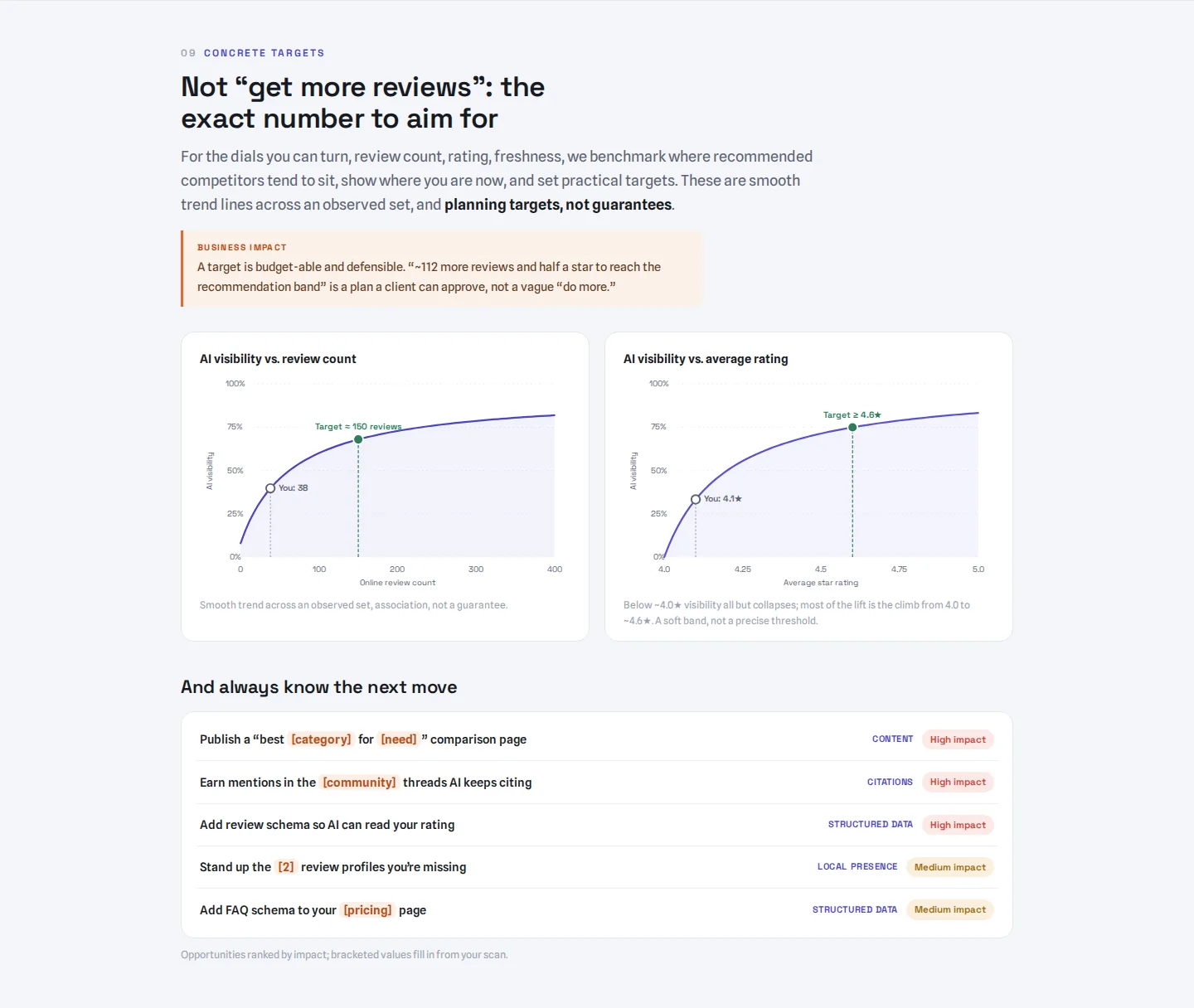
A band is more useful than copying one outlier. If recommended peers have 90–180 reviews and one chain has 1,200, assigning “1,200 reviews” as the target would be mathematically simple and operationally absurd. The useful question is where credible, comparable winners cluster.
Knowing the gap matters beyond AI visibility. Say a business has 55 reviews while repeatedly recommended peers cluster at 90–180. That business may look less proven to buyers across Maps, directories, and direct brand comparisons. It can lose a competitive edge before an AI system even weighs the evidence.
The same benchmark also sets a spending boundary. In this example, the next funded step is 15 additional genuine reviews over 90 days, followed by re-measurement. That is not a race to 180, and it is certainly not a race to the 1,200-review outlier. The band describes an observed market pattern, not a guaranteed rule.
Sparse data, mixed business types, or missing measurements should lower your confidence in the band. When that happens, widen the range, or scale the target back to a directional recommendation instead of a fixed number.
4. Choose the practical target—not the theoretical maximum
The practical target has to account for several things at once:
- The size of the gap and the time period available.
- How many customers the business actually has to draw reviews or content from.
- Team capacity and dependencies on other work.
- How confident the data is.
- The point where extra effort stops paying off.
A 90-day review target may simply be a sustainable request process plus 15 additional genuine reviews. That is not instant parity with a competitor that built up 300 reviews over ten years — and it does not need to be.
Some technical targets are directly controllable: valid entity markup on every priority page, for example. AI outcome targets are less deterministic and should often be ranges because generated answers vary.
5. Treat correlation as a clue, not a promise
Recommended competitors often have several advantages at the same time — more reviews, cleaner listings, stronger citations, better service pages, and more complete schema. Observational data alone cannot prove that any single one of these caused the recommendation.
That is why targets are treated as prioritized experiments, not proven facts:
- Fix the largest controllable gaps first.
- Keep the same prompt panel so comparisons stay fair.
- Record exactly what changed.
- Compare the next scan with the baseline.
The goal is not to manufacture certainty. It is to make a better decision under uncertainty.
Reviews are not one metric
Review count is visible and intuitive, so it makes a good worked example. But “more” can hide the actual weakness.
| Review signal | Question it answers | Possible target form |
|---|---|---|
| Count | Is there enough accumulated proof relative to recommended peers? | Reach the lower edge of a peer band over a realistic period. |
| Rating | Is sentiment materially weaker than the cohort? | Monitor a soft band; never promise or manipulate a score. |
| Recency | Is the evidence current? | No prolonged gaps; maintain a sustainable cadence. |
| Velocity | Is proof continuing to arrive? | Increase genuine monthly volume within actual customer flow. |
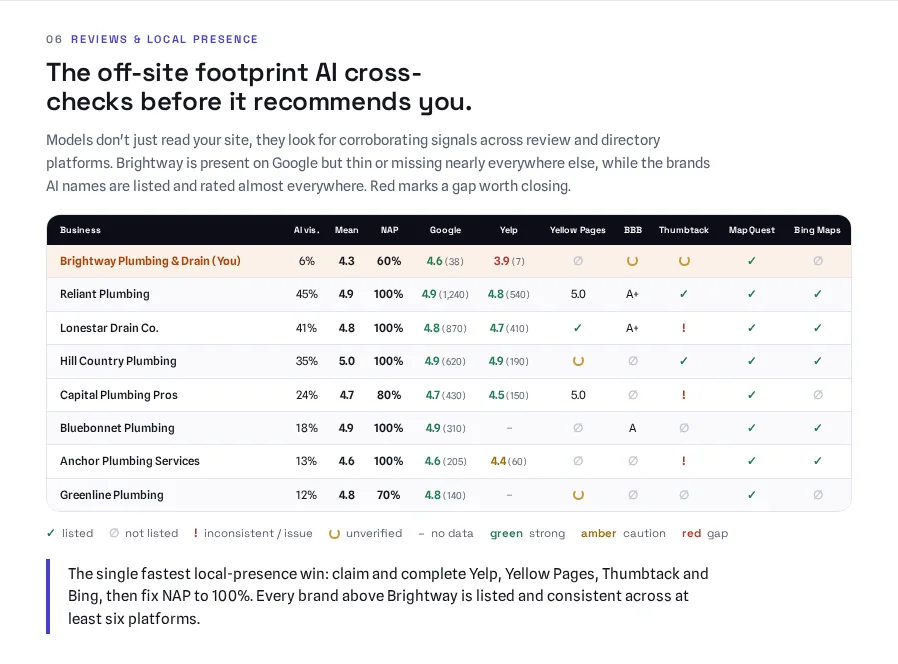
| Coverage | Is proof concentrated on one source while AI cites others? | Complete priority profiles and request reviews compliantly. |
| Responses | Does the business actively manage customer feedback? | Respond consistently, especially to substantive negative feedback. |
If your count already sits inside the recommended-peer band but recent reviews have stopped, a large acquisition campaign may solve the wrong problem. If reviews are healthy but the business has an old phone number across cited directories, listing cleanup may outrank reputation work entirely.
The same method applies beyond reviews
Plastorium calculates practical targets across the actionable indicators it collects. The target type must match the data; forcing every finding into a percentage would create false precision.
These indicators are connected. A missing service page can weaken topic coverage, citations, and AI answer accuracy. A stale listing can make AI systems less sure about your business facts, even when the website itself is correct. The plan should therefore group these dependencies instead of funding eight disconnected checklists.
For more on the measurement layer, see the AI visibility audit checklist. For source analysis, read What Is AI Citation Share?
An illustrative 90-day target plan
The following numbers are hypothetical. They show how a local service company could convert findings into an approvable plan; they are not universal Plastorium thresholds.
| Indicator | Current state | Observed peer pattern | 90-day target | Work to fund |
|---|---|---|---|---|
| Review velocity | ~1/month | Recommended peers stay current | 3–5 genuine reviews/month | Request workflow, CRM trigger, staff training |
| Review footprint | 38 on one strong profile | Peers have broader priority-source coverage | Complete two relevant profiles; add 12–15 genuine reviews overall | Profile cleanup and customer request process |
| Listing consistency | 7 material conflicts | Recommended peers are mostly consistent | 0 known critical NAP/hours conflicts | Directory corrections and canonical data sheet |
| Priority content | 2 of 6 buyer topics covered | Peers answer 5–6 | Publish 3 evidence-rich service/FAQ assets | SME interview, writing, design, internal links |
| Structured data | Entity markup only | Key facts easier to parse on peer sites | Valid entity, service, contact and area coverage on priority pages | Developer implementation and validation |
| AI outcome | Inconsistent inclusion | Leaders recur across providers | Improve reliable inclusion; eliminate known factual errors | Repeat identical prompt panel after implementation |
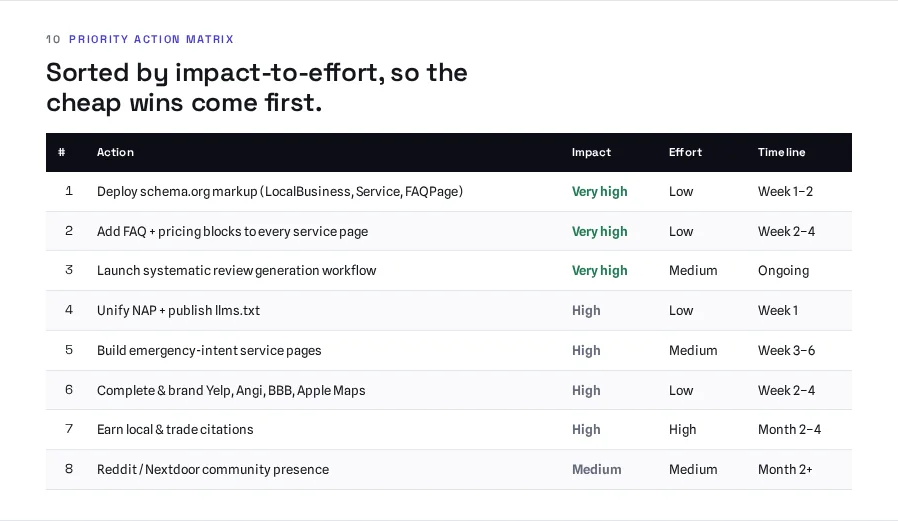
Phase 1: repair the evidence (weeks 1–3)
- Lock the canonical name, address or service area, phone, hours, categories, and URLs.
- Correct the highest-value listings and AI-cited sources first.
- Fix crawlability and deploy valid structured data on priority pages.
Phase 2: close the proof gaps (weeks 2–10)
- Launch a compliant review-request process tied to completed customer work.
- Publish the three buyer-question assets with firsthand proof, clear facts, and internal links.
- Strengthen the profiles and sources that already appear in the category’s AI citations.
Phase 3: verify and decide (weeks 10–13)
- Confirm the operational targets actually changed.
- Rerun the same prompts, providers, locations, and repetition method.
- Separate movement from noise, then fund the next largest remaining gap.
A team can now estimate hours, vendors, and media or software spend. More importantly, it can decline low-value work. Say review count is already above the peer band. The budget can then move toward whichever gap — source, content, or accuracy — is more likely to be holding visibility back.
A target is incomplete without verification
First, verify that the work itself actually happened:
- Did the profile get corrected?
- Did the review cadence change?
- Did the pages become indexable?
- Did the schema validate?
- Did the cited-source footprint improve?
Then verify the outcome using the original measurement design:
- the same buyer-intent and brand-direct prompts;
- the same relevant locations and provider mix;
- the same repeat count and scoring definitions;
- separate tracking for mention, recommendation, rank, citation, sentiment, and factual accuracy;
- a recorded before/after source set and a note of every major change shipped.
Do not declare victory because one answer improved. AI output is variable. Look for repeated movement across the panel and for supporting changes in the evidence AI can retrieve.
The real deliverable is not a longer checklist. It is a shorter queue of competitive gaps, each with a target, owner, cost, dependency, confidence level, and re-scan date.
Frequently asked questions
How many reviews do we need?
There is no universal number. Look at the range among repeatedly recommended, genuinely comparable businesses in your category and location. Then read that range alongside rating, freshness, velocity, platform coverage, and other evidence.
Does Plastorium calculate targets only for reviews?
No. Reviews are the accessible example. The method extends across collected actionable indicators: AI answer outcomes, brand accuracy, local listings, structured data, content and topic coverage, citations, technical readiness, and other measured business signals.
Does every signal get a number?
No. Numeric indicators can support ranges. Binary checks should reach a valid or complete state. Categorical findings need a required state. Sparse or noisy evidence may justify only a directional target. Good measurement avoids fake precision.
Will reaching the competitive band guarantee AI visibility?
No. The band shows association in an observed cohort, not causation or a guaranteed threshold. Reaching it removes a plausible disadvantage. The same prompt panel must then be repeated to test whether the answer pattern changed.
What if we already beat competitors on reviews?
Stop treating reviews as the default answer. Look at the remaining gaps instead:
- Incorrect facts in AI answers.
- Source coverage and citations.
- Listings and service-page evidence.
- Schema and crawlability.
- Provider-specific visibility (does it hold up on every AI system tested?).
The best target is the gap that matters most to the decision at hand — not the easiest metric to count.
Replace “do more” with a target your team can approve.
See where your business stands, which competitors AI recommends, which measurable gaps separate you, and what to fix first across reviews, citations, listings, content, structured data, and technical readiness.
Check my AI visibility